Hydrogen market for Fuel cell
and ThreeBond Solutions
 The rapid progress of technology and the automotive industry is accelerating year after year. The development of new technologies continuously opens up new opportunities for the adhesives and sealing industry. Among these emerging fields, the hydrogen sector has gained significant momentum over the past two decades, driven by the global need to reduce carbon emissions and transition toward cleaner energy solutions.
Hydrogen is now used across a wide range of applications, including fuel cell electric vehicles (FCEVs), hydrogen storage systems, electrolysers, refuelling infrastructure, and stationary power generation. In the automotive sector in particular, hydrogen fuel cells represent a key solution for achieving zero-emission mobility while maintaining long driving ranges and fast refuelling times.
Protecting valuable resources and preventing leaks have always been at the core of ThreeBond's mission. For more than 20 years, we have been actively involved in the development of high-performance sealing solutions designed to ensure the safe and reliable containment of hydrogen.
Continuous innovation in science and technology enables ThreeBond to develop new solutions every year. Through advanced material science and process expertise, we support our customers in overcoming technical challenges and contributing to a more sustainable and durable world.
Hydrogen sealing requirements
Sealing hydrogen systems presents several technical challenges due to the unique physical properties of hydrogen and the operating conditions of fuel cell systems:
- High moisture permeability, which can affect long-term performance and reliability
- High hydrogen gas permeability, due to the extremely small molecular size of hydrogen
- High manufacturing pace requirements, calling for efficient sealing processes such as:
- CIPG (Cured-In-Place Gasket) technologies
- UV-curing solutions, enabling fast curing times and high productivity
Over the years, ThreeBond has developed and validated multiple sealing solutions for hydrogen applications, evaluated using standardized Japanese Industrial Standards (JIS), including:
- JIS K 7129, for the evaluation of water vapor (moisture) permeability
- JIS K 7126, for the measurement of gas permeability, including hydrogen
Fuel cell application

A fuel cell is composed of several precisely assembled functional layers designed to generate electricity through an electrochemical reaction between hydrogen and oxygen. A single cell typically includes:
- Bipolar plates, which ensure the distribution of hydrogen and air, collect current, and provide mechanical strength
- MEA (Membrane Electrode Assembly), consisting of a proton exchange membrane sandwiched between catalyst layers and gas diffusion layers
- Sealing areas, applied around the active zone to prevent hydrogen, air, and coolant leakage
Each component must be perfectly aligned and sealed to ensure efficiency, durability, and safety under operating pressure and temperature conditions.
To guarantee tight sealing between the different components, liquid gasket materials are precisely applied directly onto the bipolar plates or frames. Depending on the production process and performance requirements, sealing is achieved using:
- FIPG (Formed-In-Place Gasket) or CIPG (Cured-In-Place Gasket) technologies
- Automated dispensing or screen-printing processes, ensuring high accuracy, repeatability, and compatibility with mass production
Once dispensed, the sealing material is cured — either by heat curing or UV curing — forming a robust and continuous gasket.


After sealing and curing, individual cells are assembled into a fuel cell stack. This stacking process involves:
- Alternating sealed bipolar plates and MEAs in a precise sequence
- Carefully aligning all layers to maintain uniform gas flow and electrical contact
- Applying controlled compression using end plates and tie rods to ensure consistent sealing performance
The final stack can consist of dozens to hundreds of individual cells, depending on the targeted power output. Proper sealing integrity throughout the stack is essential to prevent leaks, ensure safety, and maintain high efficiency.
Our solutions
ThreeBond has over 20 years of experience in the development of hydrogen sealing products and fuel cell applications. The first solutions developed were heat-curing products, such as ThreeBond 1153E. While these products offered excellent sealing performance, heat curing involves relatively long curing times, which limits production throughput.
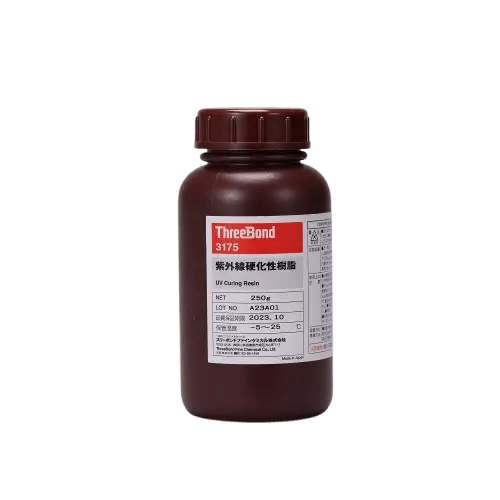
To keep pace with rapid technological advances, ThreeBond's R&D teams subsequently developed UV-curing resins, significantly reducing curing times and enabling faster, more efficient production processes. More recently, efforts have focused on screen-printable resins, allowing for higher production volumes through automated dispensing and printing.
Today, ThreeBond offers a wide range of sealing solutions — FIPGs and CIPGs — compatible with various dispensing systems, available in both heat-curable and UV-curable variants.

- One component solvent free
- Heat curing
- One component solvent free
- UV light curing
- Excellent heat, water, acid, coolant, and low moisture resistance
- Excellent shape retention, low compression set
Featured articles