Medical tubes and needles adhesives for reliable medical applications
 In the medical sector, various tools and equipment are used every day in a wide range of environments. Whether they are in direct contact with patients, healthcare professionals, or other medical materials, these devices must meet strict requirements in terms of safety, hygiene, and performance. Some are designed for repeated use after sterilization, while others are intended for single-use applications to prevent cross-contamination and ensure optimal safety.
 Among these essential devices, medical tubes and needles play a critical role in delivering fluids, administering medication, collecting samples, and supporting life-saving procedures. Their reliability depends not only on design precision and material selection, but also on the integrity of the bonds that hold their components together.
Adhesives used in the assembly of medical tubes and needles are therefore a key element in ensuring mechanical strength, leak-proof sealing, chemical resistance, and long-term durability. They must withstand sterilization processes, fluid exposure, pressure variations, and handling stresses, all while maintaining biocompatibility and regulatory compliance.
Needle bonding
Needles are among the most widely used tools in modern medicine. Often designed for single use, they are in direct contact with the patient and must therefore meet strict sterilization and safety requirements. Their reliability is critical, as they are used in procedures ranging from routine injections to complex therapeutic and diagnostic applications.

Adhesives play a key role in ensuring this reliability. They are primarily used to bond the needle cannula to its hub : the plastic component that forms the base of the device. The adhesive is precisely applied circumferentially around the needle, inside the internal cavity of the plastic hub. This controlled deposition creates a uniform and robust bonding interface between the stainless-steel cannula and its plastic base.

As a result, the needle is securely fixed within the hub, providing strong mechanical retention and preventing detachment during use. This secure assembly ensures greater precision, improved handling, and enhanced safety for both the healthcare professional and the patient.

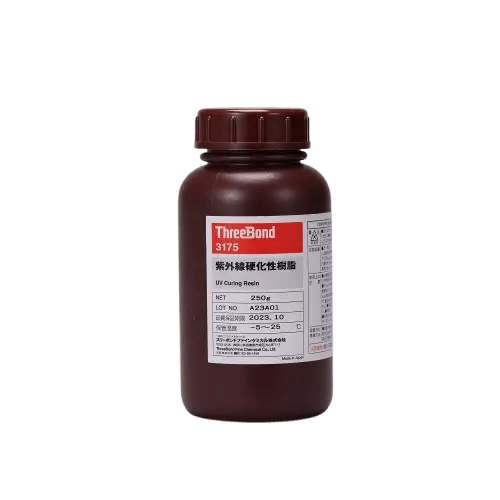
- High-viscosity type UV-curing resin
- Good adhesion to plastics, such as polycarbonate and acryl
- Excellent thick film curability by UV curing
- Conforming to ISO10993
Medical tubes applications
 Medical tubes are connected to a wide range of medical devices, whether for perfusion systems, intravenous drip sets, drainage lines, or respiratory applications. As integral components of fluid management systems, they are frequently coupled with connectors, chambers, or other devices. These junctions must often be securely sealed to prevent leakages, contamination, or air ingress that could compromise patient safety.
In drip tubes, adhesives are used to bond the tubing securely to the drip chamber inlet and outlet, ensuring a leak-tight and air-tight connection. This bonding guarantees structural stability, consistent drop formation, and reliable fluid flow throughout the infusion process, even during handling, transportation, or patient movement.

In other applications, it may be necessary to bond the open end of a tube directly to a connector or fitting. This ensures secure mechanical fixation, maintains internal pressure integrity, and prevents accidental disconnection during use. A properly selected adhesive also helps accommodate material differences (such as PVC, PU, PE, or PP) while maintaining flexibility, chemical resistance, and long-term durability.

- Instant adhesive with light-curing property
- Low viscosity and excellent gap penetration
- Blushing can be prevented by irradiation with light
- In areas not exposed to light, it can cure with moisture
Featured articles